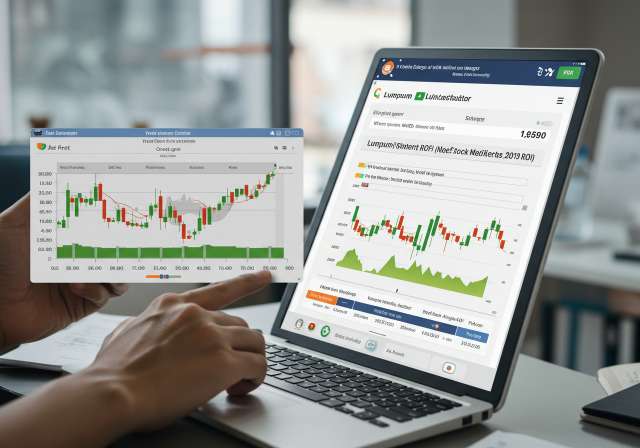
Best Flat Fee Brokerage Apps in India: A Detailed Comparison

Looking for the best flat fee brokerage app in India? Compare top discount brokers, their fees, features & user experience. Start investing in the Indian stock
Looking for the best flat fee brokerage app in India? Compare top discount brokers, their fees, features & user experience. Start investing in the Indian stock market (NSE & BSE), mutual funds & IPOs with zero brokerage! Find out which is the best flat fee brokerage app for your investment needs.
Best Flat Fee Brokerage Apps in India: A Detailed Comparison
Introduction: The Rise of Discount Brokers in India
The Indian stock market is booming, with more and more individuals taking the plunge and investing in equities, mutual funds, and other financial instruments. Fueling this growth is the emergence of discount brokers, who offer a simplified and cost-effective way to participate in the market. Traditional brokerage houses often charge percentage-based brokerage fees, which can eat into your profits, especially for frequent traders. Flat fee brokerage apps, on the other hand, charge a fixed fee per trade, regardless of the transaction size, making them an attractive alternative for many investors.
This article aims to provide a comprehensive comparison of some of the best flat fee brokerage apps available in India, helping you make an informed decision based on your individual needs and investment style. We’ll delve into the fees, features, user experience, and other important aspects of each platform, allowing you to choose the one that aligns best with your financial goals.
Understanding Flat Fee Brokerage: Why It’s Gaining Popularity
Before diving into the specific apps, let’s understand why flat fee brokerage is becoming increasingly popular in India.
- Cost-Effectiveness: As mentioned earlier, the fixed fee structure can significantly reduce brokerage costs, especially for high-volume traders or those dealing with larger transaction sizes. Imagine trading ₹1 lakh worth of shares. A 0.5% brokerage charge would amount to ₹500, while a flat fee of ₹20 would save you a substantial amount.
- Transparency: The flat fee structure is straightforward and easy to understand, eliminating any hidden charges or surprises.
- Accessibility: Discount brokers often offer user-friendly apps and platforms, making it easier for beginners to navigate the market and execute trades.
- Technological Advancements: The rise of technology has enabled discount brokers to offer efficient and seamless trading experiences at a fraction of the cost compared to traditional brokerage houses.
Key Factors to Consider When Choosing a Flat Fee Brokerage App
Selecting the right brokerage app requires careful consideration of several factors. Here are some key aspects to keep in mind:
- Brokerage Fees: This is the most obvious factor. Compare the flat fee charged per trade for different asset classes (equity, derivatives, etc.). Also, look for any hidden charges or account maintenance fees.
- Platform Features: Consider the features offered by the platform, such as charting tools, research reports, news updates, and order types (e.g., stop-loss orders, bracket orders).
- User Interface: The app should be intuitive and easy to use, especially if you’re a beginner. Look for a clean and uncluttered interface that allows you to quickly access the information you need.
- Customer Support: Reliable customer support is crucial. Check if the broker offers support through multiple channels, such as phone, email, and chat. Read reviews to gauge the quality of their customer service.
- Trading Platforms: Does the broker offer a mobile app, a web-based platform, or both? Choose a platform that suits your preferred trading style.
- Investment Options: Ensure the app offers access to the investment options you’re interested in, such as equity, derivatives, mutual funds, IPOs, and bonds.
- Account Opening Process: A smooth and hassle-free account opening process is essential. Check the documentation required and the time it takes to open an account.
- Security: Security is paramount. Ensure the broker is registered with SEBI and has robust security measures in place to protect your account and personal information.
- Research & Analysis: Access to research reports and analysis tools can significantly enhance your investment decisions.
Top Flat Fee Brokerage Apps in India: A Detailed Comparison
Now, let’s take a closer look at some of the leading flat fee brokerage apps in India:
Zerodha
Zerodha is one of the most popular discount brokers in India, known for its user-friendly platform and low brokerage fees. It charges a flat fee of ₹20 per executed order for intraday and derivatives trading. Equity delivery trades are completely free. Zerodha offers a wide range of investment options, including equity, derivatives, mutual funds, and IPOs.
- Pros:
- Low brokerage fees
- User-friendly platform (Kite)
- Wide range of investment options
- Direct mutual fund investments
- Strong reputation and large user base
- Cons:
- Can be slightly overwhelming for complete beginners
- Customer support can be slow at times
Upstox
Upstox is another popular discount broker that offers a flat fee of ₹20 per order for intraday and derivatives trading. Equity delivery trades are also free. Upstox provides a user-friendly platform with advanced charting tools and features. They also offer a simplified option chain for options trading.
- Pros:
- Competitive brokerage fees
- User-friendly platform with advanced charting tools
- Simplified option chain
- Good customer support
- Cons:
- Limited investment options compared to some other brokers
Groww
Groww is a popular platform, particularly among beginners, due to its simple and intuitive interface. They offer free equity delivery and charge a flat fee of ₹20 for intraday and F&O trading. Groww also provides a platform for investing in mutual funds and US stocks.
- Pros:
- Extremely user-friendly interface
- Free equity delivery
- Easy mutual fund investments
- Investment in US stocks
- Cons:
- Limited features compared to some other brokers
- F&O brokerage can be confusing for new users
Angel One
Angel One (formerly Angel Broking) is a well-established brokerage firm that has transitioned to a discount brokerage model. They offer a flat fee of ₹20 per order for intraday, F&O, currency, and commodity trading. Equity delivery is free. Angel One provides access to a wide range of investment options and research reports.
- Pros:
- Wide range of investment options
- Access to research reports and advisory services
- Established brand and reputation
- Cons:
- Platform can be complex for beginners
5Paisa
5Paisa offers a unique flat fee model where you pay a flat monthly fee for unlimited trading. They have different plans to choose from based on your trading volume and needs. This can be beneficial for very active traders.
- Pros:
- Unique flat monthly fee model
- Wide range of investment options
- Cons:
- Flat monthly fee may not be cost-effective for low-volume traders
Beyond Brokerage: Other Factors to Consider
While brokerage fees are a primary concern, it’s crucial to consider other factors that can impact your overall investment experience:
- Account Opening Charges: Some brokers charge a fee for opening an account. Compare these charges across different platforms.
- Dematerialization (Demat) Account Maintenance Charges (AMC): Most brokers charge an annual fee for maintaining your Demat account.
- Fund Transfer Charges: Check the charges for transferring funds to and from your trading account.
- Platform Stability: Ensure the platform is stable and reliable, especially during periods of high market volatility.
- Educational Resources: Some brokers offer educational resources, such as articles, videos, and webinars, to help you improve your investment knowledge.
SIPs, Mutual Funds and Long-Term Investing
Most of these apps also facilitate investments in Mutual Funds, often with the option to start a Systematic Investment Plan (SIP). Investing in mutual funds via SIP allows you to invest a fixed amount regularly, benefiting from rupee cost averaging. For long-term investments aimed at tax saving, consider investing in Equity Linked Savings Schemes (ELSS) offered by various mutual fund houses. ELSS investments qualify for tax deduction under section 80C of the Income Tax Act, up to a limit of ₹1.5 lakh per financial year. Besides ELSS, you might also consider contributing to Public Provident Fund (PPF) or National Pension System (NPS) for retirement planning.
Conclusion: Choosing the Right Flat Fee Brokerage App for You
Choosing the best flat fee brokerage app depends on your individual needs and investment style. Consider your trading frequency, investment preferences, and comfort level with technology. If you are a beginner, a platform with a user-friendly interface and good educational resources might be ideal. If you are an active trader, a platform with advanced charting tools and low brokerage fees might be more suitable.
Ultimately, the best approach is to research thoroughly, compare different options, and perhaps even try out a few demo accounts before committing to a particular platform. Investing wisely is crucial for your financial future, and selecting the right brokerage app is a key step in that journey.
Tags: best brokerage app, compare brokerage apps, discount brokerage, fixed brokerage, flat fee brokerage, futures trading, low commission brokers, online trading platform, options trading, stock trading app
About Me

Arjun Mehta
Author/Writer
Hello, I’m Arjun Mehta, a passionate trader and market analyst who loves sharing insights, strategies, and experiences to help others understand the markets, make informed decisions, and grow with confidence in their trading journey.
Follow Me
Connect with me and be part of my social media community.
Leave a Reply